JK Rowling in 1998 On The Birth of Harry Potter
The first step in your Harry Potter adventure should be the very first step in the journey of how the book came about.
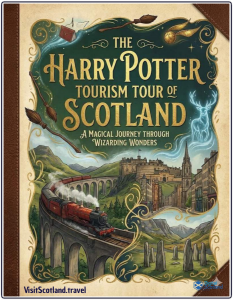 On 23 July 1998, acclaimed author JK Rowling sat down with ITN in Nicolson’s Café in Edinburgh to talk about the enormous success of the Harry Potter series.
Weeks before, the second of what was to be a seven-book series had been released, and Rowling was working on the third.
In 1990, a 25-year-old single mother named Joanne Rowling was on a delayed train from Manchester to London King’s Cross when the idea of a young wizard simply “fell into her head,” fully formed.
She saw a skinny, black-haired boy with glasses who didn’t yet know he was a wizard. She had no pen and was too shy to ask for one, so she sat and thought about him for the four-hour journey, letting the world build itself in her mind.
Jo (as she was known then) was broke, recently unemployed, and clinically depressed after her mother’s death from multiple sclerosis earlier that year.
She had trained as a teacher but was living on benefits in Edinburgh, Scotland. Over the next five years, she wrote the first book in longhand in cafés (often Tom’s, which later became the inspiration for places like the Leaky Cauldron) while her baby daughter Jessica slept in a pram beside her. She warmed the flat with one-bar electric heaters and typed the manuscript on an old manual typewriter.
The wizard boy now had a name: Harry Potter. The school became Hogwarts. The dead parents, the lightning-bolt scar, the Dursleys, Voldemort, Quidditch, the Sorting Hat—all of it poured out. She planned the entire seven-book arc from the beginning, writing little notes and charts on scraps of paper. She has said that the failure of her short first marriage (to a Portuguese journalist) and the grief over her mother deeply shaped the series’ central theme: death and how we deal with it.
When Harry Potter and the Philosopher’s Stone was finished in 1995, she sent the first three chapters to a few agents. The second one, Christopher Little, took her on. The manuscript was rejected by twelve publishers. Finally, in 1996, Barry Cunningham at the small children’s imprint Bloomsbury bought it for an advance of £2,500. Even then, Cunningham warned her that children’s books didn’t make much money and she should get a day job.
Bloomsbury printed only 500 hardback copies in the first run (about 300 went to libraries). The book won a Smarties Prize, got great reviews, and then, in 1997, an American editor named Arthur Levine saw it at the Bologna Book Fair and started a bidding war. Scholastic bought the U.S. rights for $105,000—an unheard-of sum for a children’s book by a British debut author. Rowling cried when she heard; it meant she could stop teaching and write full-time.
The title was changed in America to Harry Potter and the Sorcerer’s Stone because the publisher worried “Philosopher” sounded too esoteric. The rest—six more books, the midnight release queues, the films, the theme parks, the billions of dollars, the cultural phenomenon—is history.
But it all started with a delayed train, a shy woman too polite to borrow a pen, and a boy who lived.