Murder at the Devil’s Advocate – The Poisoned Anniversary Dram
Detective Inspector Elara MacLeod unmasks Alistair Grant’s ex-wife Lydia as the killer who poisoned his priceless 1972 Macallan with cyanide.
 Advocate’s Close drops away from the Royal Mile like a secret the city forgot to keep.
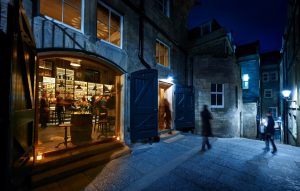
Halfway down the steep, narrow wynd, a warm amber glow spills from the arched doorway of The Devil’s Advocate, a bar carved into the bones of a Victorian pump house.
Exposed brick sweats with two centuries of damp, iron girders arc overhead like the ribs of some sleeping beast, and four hundred whiskies stand sentinel along the back bar, glinting under low Edison bulbs. On a frozen December night, the place smelled of peat smoke, orange peel, and something far more bitter.
Detective Inspector Elara MacLeod pushed through the heavy door at 00:17, coat collar turned up against the sleet that hissed off the cobblestones.
Uniforms had already sealed the terrace; fairy lights still twinkled over empty tables as though nothing had happened. At one of those tables, Alistair Grant lay slumped forward, cheek pressed to the wet slate, a crystal Glencairn glass tipped on its side beside his outstretched hand. The last dram he would ever taste had left a perfect amber ring on the table, like a full stop at the end of a very expensive life.
A Dram That Stopped a Heart
“Cyanide,” the on-scene pathologist confirmed without looking up. “Fast. Odour of bitter almonds still faint under the malt.”
Elara crouched, careful not to disturb the scene. Grant had been seventy-one, silver-haired, immaculately tailored, the kind of man who could tell a 1940s Macallan from a 1950s by smell alone. Tonight he had come to celebrate the sale of three bottles from his private collection—bottles worth more than most people’s houses—with a select circle of acquaintances. One of them, it seemed, had decided the celebration should be his wake.
|
 The Murder Scene
The manager, Callum Drummond, hovered nearby, wringing a bar towel as though it might confesses. “He arrived at eight,” Callum said. “Booked the corner booth on the mezzanine. Brought his own bottle—a 1972 Macallan single cask, anniversary edition, one of only twelve in existence. He liked to show it off. Said tonight he’d let a few of us taste what heaven cost.”
Elara climbed the wrought-iron staircase to the mezzanine. From up here the bar looked like a stage set: bartenders in black aprons moving with choreographed grace, flames licking under copper pans in the open kitchen, shadows pooling in the old pump chamber below. She could see why Grant loved the theatre of it. She could also see half a dozen places where someone might linger unseen.
Four Glasses, One Empty Chair
Four people had shared Grant’s table that night.
First, Fiona Reid, head bartender and Grant’s unofficial protégée, red-eyed and clutching a cup of tea that had long gone cold. “He taught me everything,” she whispered. “Said when he died he’d leave me the 1965 Bowmore that won the World Whiskies Award. I’d never have—”
Second, Marcus Hale, Grant’s business partner, a venture capitalist whose smile never reached his eyes. “We were closing the deal tonight,” Hale said, swirling the ice in his untouched Negroni. “Alistair wanted witnesses. The bottles were going to auction in Tokyo next month. Forty-three million, give or take.”
Third, Lydia Grant, the ex-wife, elegant in charcoal cashmere, lips painted the same red as the devil on the bar’s logo. “I wasn’t invited,” she said coolly. “I simply dropped by to remind him the divorce settlement was three months overdue. He laughed and poured me a dram anyway. Generous to the end.”
Fourth—a late arrival—Dr. Hamish Kerr, retired toxicologist from the university, an old university friend of Grant’s who had texted Grant only that afternoon asking to “drop in for a quick one.” Kerr had left early, complaining of a migraine, forty minutes before Grant collapsed.
Elara spent the next four hours turning the bar inside out.
Forensics found the cork of the 1972 Macallan had been removed and resealed with surgical precision; a microscopic puncture in the lead capsule betrayed where the cyanide had been injected. The bottle itself was spotless—wiped clean of prints except for Grant’s own on the base. Whoever had doctored it had worn gloves and known exactly what they were doing.
The Devil in the Pump House
Elara descended into the old pump chamber beneath the bar, now a private dining room lined with antique whisky casks. The air was colder here, thick with the ghost of peat and Victorian engineering. In a gap behind a 140-year-old hogshead she found a tiny glass vial, no bigger than a thimble, its rubber stopper dusted with cyanide crystals. A single auburn hair—long, dyed, expensive—clung to the rim.
Lydia Grant’s natural colour, Fiona the bartender quietly confirmed, was mouse-brown.
The Widow’s Toast
At 05:40, as the sky over the castle turned the colour of watered blood, Elara had Lydia brought to the mezzanine again. The bar staff had gone home; only the low hum of the fridges and the distant drip of melting sleet remained.
“You came early,” Elara said, laying out stills from the CCTV: Lydia slipping into Advocate’s Close at 18:47, hood up, moving with purpose. Another frame showed her descending the iron stairs to the pump chamber at 19:12 and emerging nine minutes later. “You knew Alistair’s habits. You knew he always poured the first dram himself, with ceremony. All you had to do was wait until he turned to greet Marcus, lean across, and switch his glass with the one you’d prepared.”
Lydia’s composure cracked like thin ice. “He took everything from me,” she hissed. “The house in Moray Place, the villa in Tuscany, the collection he loved more than he ever loved me. Forty-three million, and he was going to leave it to auction houses and bloody bartenders. I only took what was mine.”
She reached into her handbag—slowly, theatrically—and produced the real 1972 Macallan, untouched, wrapped in silk. “I was going to disappear with this. One bottle. Twelve million on the black market. A new life.”
Elara cuffed her beneath the devil’s painted grin that watched from the wall.
Slàinte Mhath to a Ghost
By dawn the bar staff returned to find the terrace lights still burning and the mezzanine empty save for an untouched dram glowing like liquid fire in the half-light. Callum poured it back into a spare bottle, labelled it “Evidence—Do Not Drink,” and locked it in the safe.
The Devil’s Advocate reopened that evening. The fairy lights twinkled, the whiskies gleamed, and the old pump house kept its secrets once more—except for one, now handcuffed and on her way to the High Court, who would never taste nothing but regret for a very long time.
Case closed. Slàinte mhath, Alistair Grant. May the next dram be untainted.