1297: The Spark at Lanark – How William Wallace Ignited the Scottish War of Independence
 In the second week of May 1297, the town of Lanark in Clydesdale woke to the sound of steel on steel, screaming horses, and the crackle of burning thatch.
By the time the sun was fully up, the English sheriff lay dead in the street, the garrison was slaughtered or fled, and a little-known knight named William Wallace had just lit the fuse that would explode into the First War of Scottish Independence.
What happened in Lanark was not a planned national uprising. It was a sudden, brutal, and very personal act of vengeance that snowballed within days into a general revolt across southern and central Scotland.
The Background: Scotland on Its Knees
- 1296: Edward I had crushed John Balliol at Dunbar, deposed him, and turned Scotland into an occupied province.
- English sheriffs and garrisons were installed in every major burgh and castle.
- Heavy taxes, forced levies of food, and systematic humiliation of the Scottish nobility created seething resentment.
- By early 1297 small bands of resistance were already active: Malcolm Wallace (William’s older brother) is said to have been executed in 1296; Andrew Moray was raising the north-east; James Stewart and Robert Wishart, Bishop of Glasgow, were secretly organising.
The Traditional Story (and what historians accept)
The fullest account comes from the 15th-century poet Blind Harry, writing 170 years later, but key details are confirmed by English administrative records.
On or about 4–7 May 1297:
- William Wallace, aged roughly 27, was living as an outlaw in or near Lanark with a small band of followers.
- He had begun a relationship with a young Lanark woman named Marion Braidfute (her existence is debated, but the name appears in 13th-century charters of the Braidfute family of Lamington).
- The English sheriff of Lanark, Sir William Heselrig (or Hazelrigg), either tried to arrest Wallace or publicly executed Marion as bait to draw Wallace out (Blind Harry’s version), or simply provoked Wallace by attempting to seize him in the street (more likely).
- That same night Wallace and a handful of men (estimates range from 12 to 50) slipped into Lanark after dark.
- They split into two groups: one attacked Heselrig’s residence in the castle or fortified house near St Kentigern’s church and hacked the sheriff to death in his bed or courtyard.
- The second group set fire to English quarters and killed soldiers as they stumbled out.
- By dawn the English presence in Lanark had been destroyed. Wallace and his men vanished into the surrounding hills.
English records confirm that Heselrig was indeed killed in May 1297 and that Lanark’s garrison was “annihilated.” Edward I’s government later offered a land grant to anyone who could capture Wallace alive or dead – the first time his name appears in official documents.
Immediate Consequences
The killing of an English sheriff was an act of open rebellion. Within weeks the flames spread:
- May–June 1297: Revolt erupted almost simultaneously across Scotland.
- Sir William Douglas (future father of the “Good Sir James”) attacked Scone.
- Robert Bruce (the future king) and the Bishop of Glasgow rose in the south-west.
- Andrew Moray broke out of English custody and raised the north.
- James Stewart, the High Steward, joined with his retainers.
- By midsummer Wallace had several hundred men under his command and was operating in Clydesdale and Ayrshire, ambushing English supply columns and executing collaborators.
- The English were forced to divert troops from the planned campaign in France to deal with the crisis.
The Site Today
Lanark is still a quiet market town, but traces of the 1297 events remain:
- St Kentigern’s Church (rebuilt, but on the medieval site) – traditionally where Wallace and Marion were secretly married.
- Castlebank Park – the probable location of Heselrig’s fortified house (nothing visible remains except earthworks).
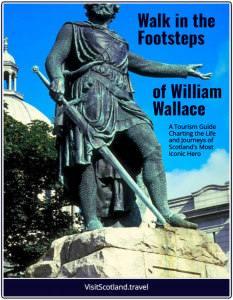
- The Wallace Statue (1888) on St Nicholas Church tower, showing Wallace in chain-mail with drawn sword.
- The Wallace Cave, a sandstone overhang 4 miles south on the Mouse Water near Cartland Crags, is traditionally one of his early hiding places (easy 30-minute walk from Lanark).
Why Lanark Mattered
Stirling Bridge is the battle everyone remembers, but Lanark was the moment the war actually began. It transformed Wallace from a fugitive into a national leader. As the contemporary English chronicler Walter of Guisborough later admitted with grudging respect:
“A certain malefactor named William Wallace, who had been outlawed for the killing of the sheriff of Lanark, gathered a great band of wrong-doers and became their captain… and thus the war began anew.”
Stand in Lanark’s High Street on a spring evening, look up at the castle mound silhouetted against the sky, and you can still feel the sudden, violent spark that turned a personal feud into a fight for a nation. May 1297 was the night Scotland refused to stay conquered.